
Sept 30 - Nov 1, 2026
Opening Reception: Friday, October 2, 6-8 pm
Robin Levandov
”The Color of Memory”
Patty Adams
“Bathers and Bacchanals”
Benjamin Sears
”Dwellings”

Robin Levandov: “Untitled,” oil on paper on panel, 12“ x 9”, 2021
Robin Levandov
”The Color of Memory”
Click here to see an online preview
Abstract painting is the stuff of daydreams. And pure play.
These paintings are a record of moments experienced; of persons, places or things; of sunny, stormy or foggy days; and of feelings, memories or daydreams.
Painting is my door to enter a state of play. Curiosity and intuition are my guides. The question I most often ask myself is ”what if…” Even if I begin by imagining a world, something unexpected always appears. That’s when painting gets really interesting: when it resists and asks me to follow.
I enjoy painting different subjects so that i am constantly challenged. Similarly, I explore different techniques and tools. This show features work over a few years as well as an array of strategies. For example, a selection of 9” x 12 “ work represents my commitment during Covid to painting “one a day.” Another strategy involved using solely leftover paint from my most recent palette. Regardless of the hour, I would remain at work in my studio until the piece arrived somewhere worth staying.
A painting comes alive when it stops giving answers and leaves something unresolved. For me, abstract work often is not about some thing or idea but is a record of my process. Thus, each piece is a conversation between intention and surrender. I make marks then revise, obscure and sometimes rediscover.
What emerges is not a portrait of an experience but the residue of memory: my moments of hesitation and exuberance, fragments of remembrance and flashes of emotional states.
I have always thought of art as similar to poetry, that it can't be proven and yet, if done right, has a sense of unmistakable aura.
—Sterling Ruby

Patty Adams: "Bacchanal with Picnic," 60" x 72", oil and collage on canvas, 60" x 72", 2026
Patty Adams
“Bathers and Bacchanals”
There are bodies and there is nature. They are profoundly connected.
In this work I have drawn on the art historical imagery of the nude figure in nature both as bathers and revelers. I have tried to capture their joy and pleasure of being alive in the natural world.
I was inspired by discovering Grace Hartigan and how she used Henri Matisse’s “Bathers by a River” as an inspiration for her own “River Bathers.” Her painting was strangely like and yet unlike Matisse’s. I wanted to have a similar experience.
The above painting is based on a similar but more general inspiration from Rubens and Poussin and their paintings of orgiastic dancers and satyrs worshipping Venus and Pan. This painting is oil on canvas but its surface has been enlivened by collaged elements of paper and theatrical gels.
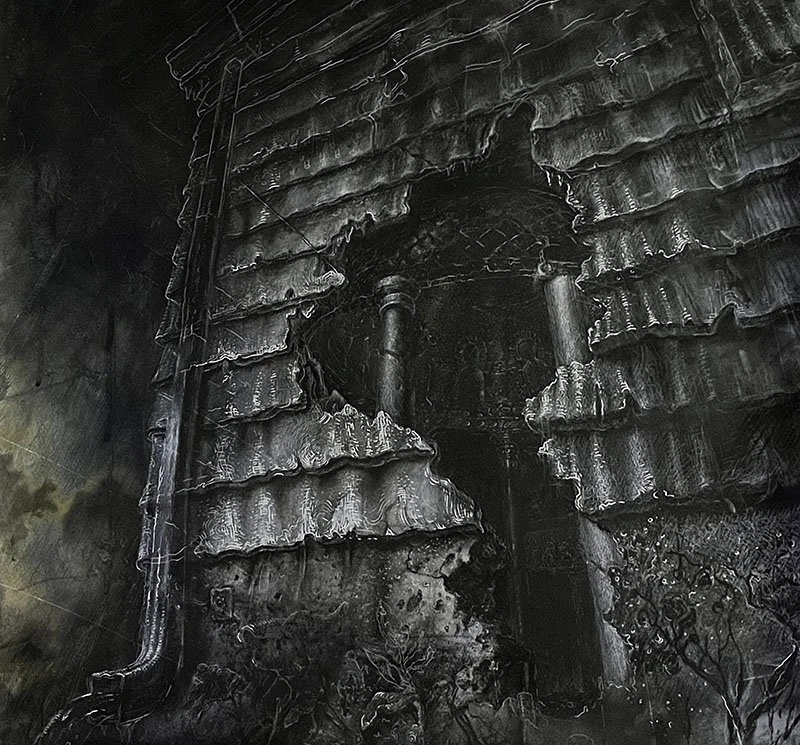
Benjamin Sears
”Dwellings”
The architectural forms in these paintings and drawings feel, to me, sentient. And like living beings, they possess complex psychological systems. They also hold memories of past experiences.
These imagined structures rarely remain still. They process their inner lives through movement, transformation, and invention. Some buildings remain closed and opaque, even as they may long to reveal what lies within them. Others unintentionally become transparent - vulnerably exposing themselves.
Existing as both objects and inhabitable spaces, these dwellings use imagination to grow past their limitations.