
June 3 - 28, 2026
Opening Reception: Friday, June 5, 6-8 pm
Cynthia Roberts: “Mango Season”
Sarah Hulsey: “Time Present and Time Past”
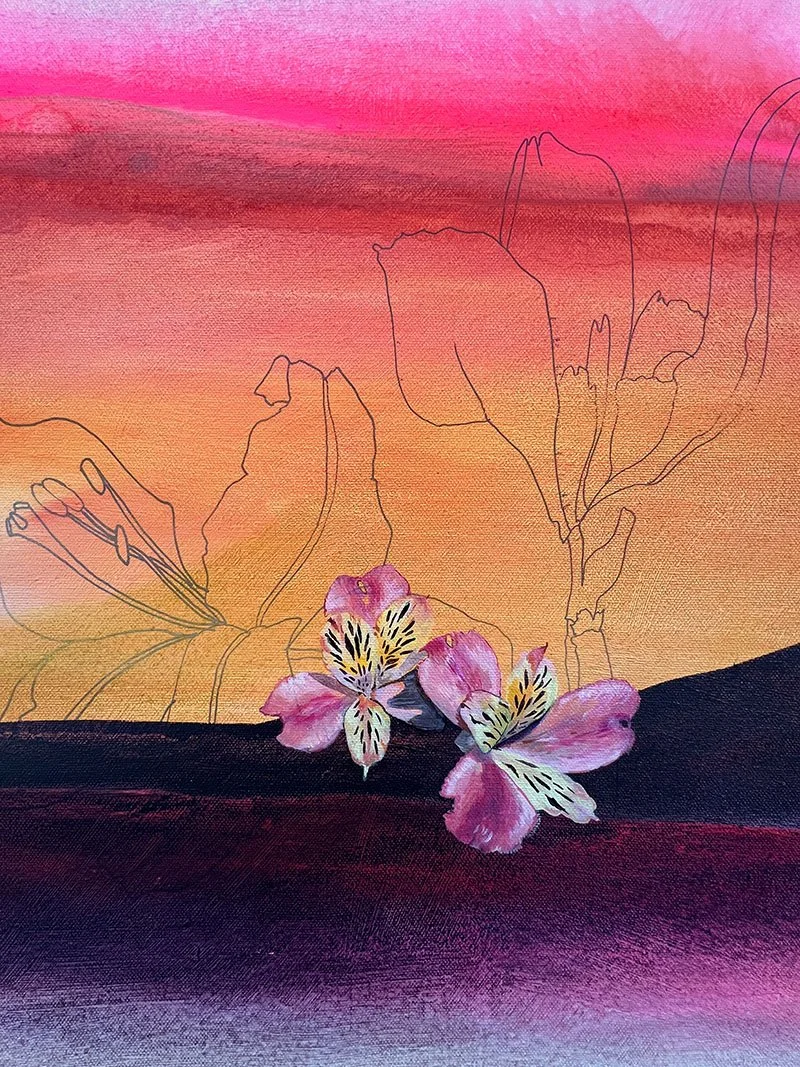
Cynthia Roberts: "Night Remembering Day" (detail), acrylic on canvas, 30” x 40”, 2026
Cynthia Roberts: “Mango Season”
In these works, I’m exploring the act of witnessing through emergence and submergence of imagery in color-rich abstract environments. Careful botanical line drawings appear and then step back from the viewer, as more literal depictions step forward. Each painting is an ecosystem where the process of observation creates an interior life; plants appear to remember themselves, their history, their previous state perhaps, and the painter becomes transcriptionist of that immersive world, rather than arbiter.
Mango season begins in March and runs through June in Costa Rica, where I spend chunks of time each year. I was happily surprised to see the connection to the season. People stop their cars, motorbikes, and walks to collect ripe mangos from a roadside tree. Toucans, parrots, and other birds are drawn to the trees with ripening mangoes to fill themselves. There is an innate magnetism; if you have a mango tree near you, it will be known. The period arcs the transition from dry to rainy season. The mangoes ripen and sweeten in the hot dry air.
I pull inspiration for this series from the rich color palette in Costa Rica, as well as a recent artist residency in the Canary Islands, a Spanish territory off the coast of Africa. I am continuously drawn to rich natural environments where the layers of visual and sonic stimulation are a kind of synesthetic experience. I hope these works will give you a taste.
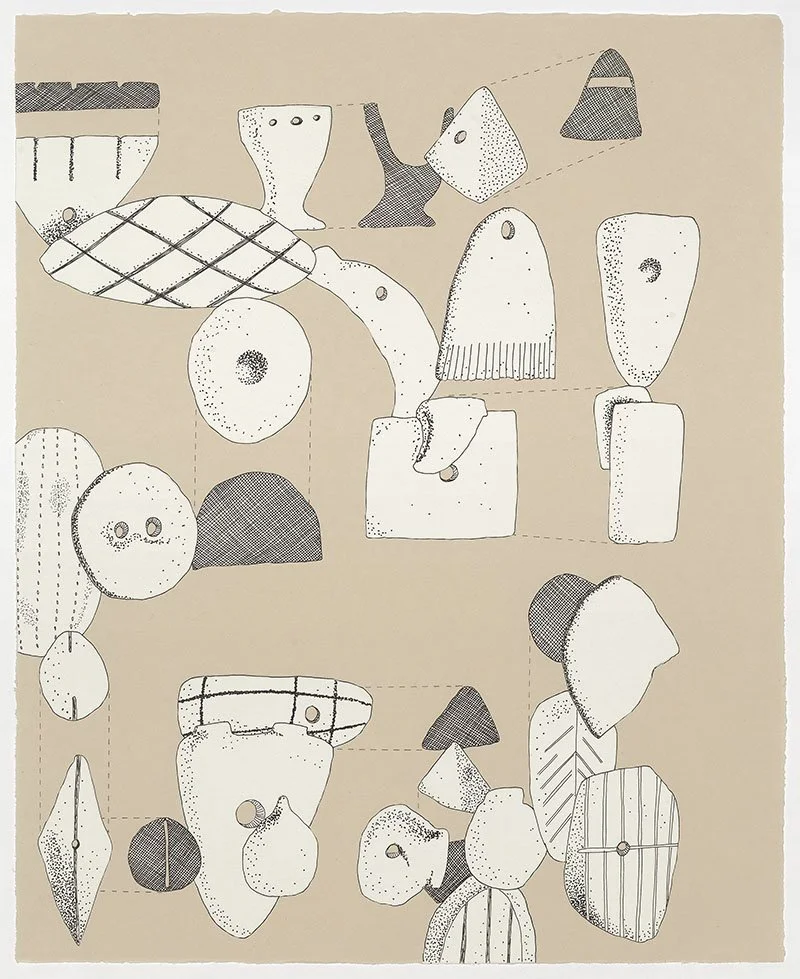
Sarah Hulsey: “Ideograms I,” ink, pencil, and collage on gampi paper, 17" x 21", 2026
Sarah Hulsey: “Time Present and Time Past”
I have become fascinated with counting tokens from Mesopotamia that are thought to be the precursors to cuneiform writing. I am equally compelled by the precise drawings of them in archeological scholarship, often with cross-sectional views and sorted by shape, size, and markings into orderly arrays. When seen in aggregate, they have a quality both rational—their sortings appear very regimented—and arcane. As images, the tokens resist identification, and yet they take on characteristics of familiar objects.
I am reminded of the extraordinary, evocative Borges story, “Tlön, Uqbar, Orbis Tertius,” in which an imaginary, mysterious world called Tlön slowly infiltrates our own. Lost objects there tend to duplicate themselves, becoming longer and more exaggerated with each duplication. When these secondary and tertiary objects, dubbed “hrönir,” start to be produced in our parallel world, Borges says it is “of invaluable aid to archaeologists, making it possible not only to interrogate but even modify the past, which is now no less plastic, no less malleable than the future.”
In this show, I explore the ancient tokens and schematic drawings of them, imagining their ability to translate between parallel worlds and spans of time.