
March 4 - 29, 2026
Opening Reception: Friday, March 6, 6-8 pm
Closing Reception: Sunday, March 29, 2-5 pm
Pam Kainz: “Present Tense”
Barbara Burgess Maier: “Findings”
Amanda Bittner: “Uneven Ground”
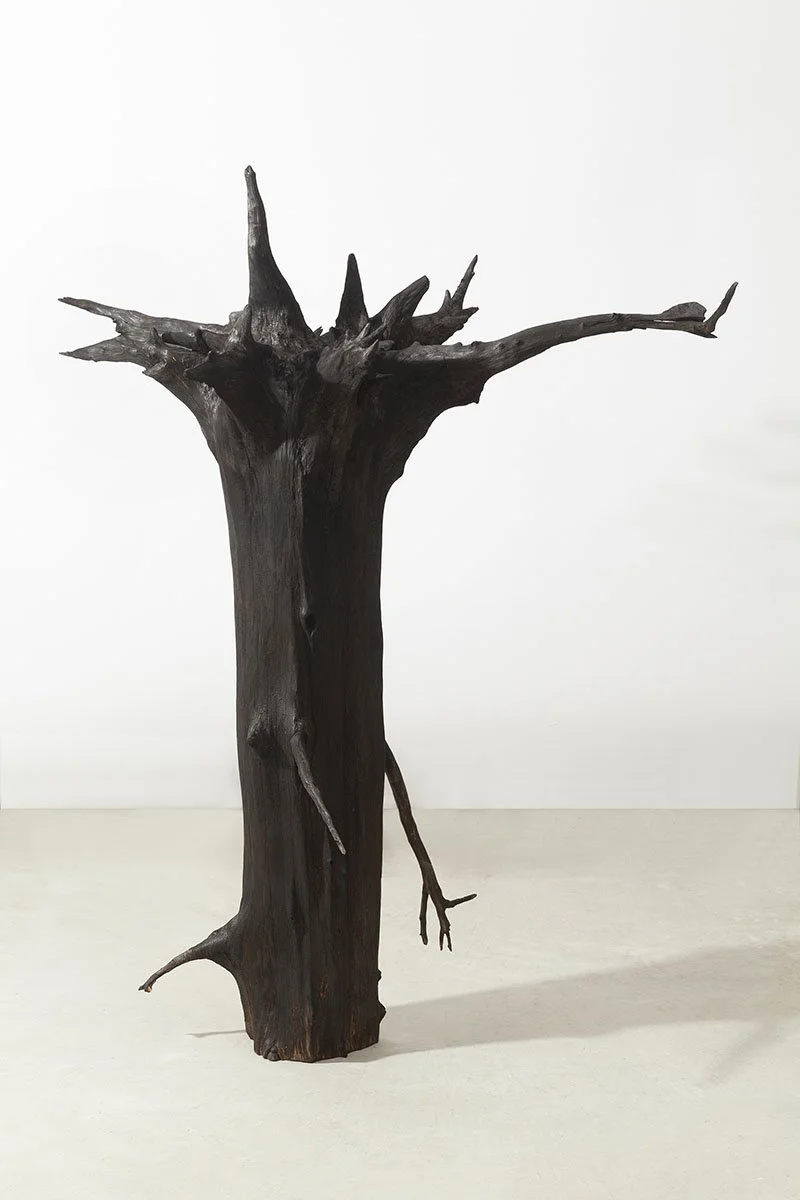
Pam Kainz: “Root 1,” 36 x 30 x 19”, Fire on eastern red cedar (Juniperus virginiana) root, 2024
Pam Kainz: “Present Tense”
I use fire as a tool to mark and sculpt wood. My practice is grounded in observation, attending closely to what the material already holds and working in response to its inherent qualities. When my torch meets wood, a carefully controlled yet inherently unpredictable dialogue begins, one that requires full presence and attention.
The surfaces of found cedar roots are torched to reveal, preserve and honor their natural forms. Their branching arm-like structures extend outward, echoing systems of growth and exchange, suggesting an ongoing search for nourishment and connection.
The Edge Burns series explores the material transformation as painted wood yields to fire. Working with single colors on wood panels, I use controlled burning to activate the painted surfaces. Each panel holds a charged tension, where stillness and change negotiate their boundaries.
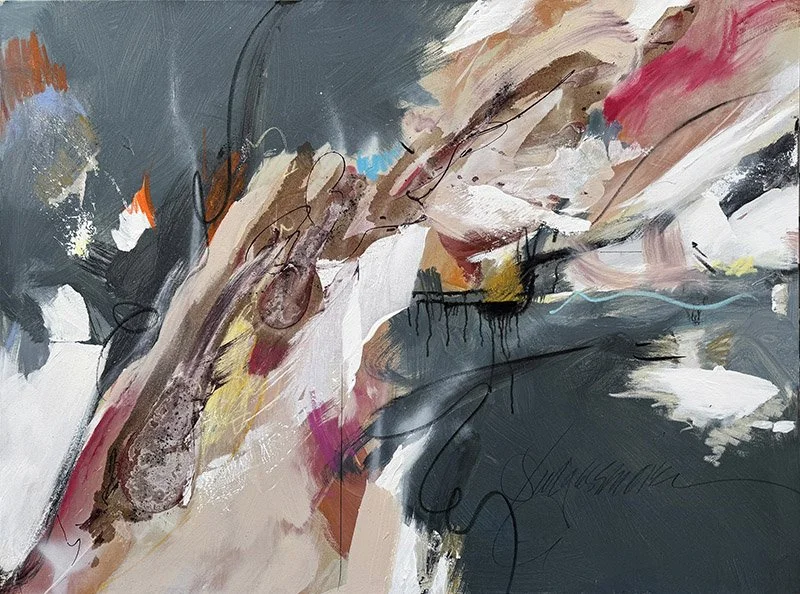
Barbara Burgess Maier: “Joy/Rage,” mixed media on canvas, 36” x 48”
Barbara Burgess Maier: “Findings”
These paintings reflect precious ideas inspired by people and places and from my interaction with them.
Digging around on the canvas to uncover truths to be visually told, I search beneath the surface of things.
An archaeologist of human interaction and ideas that confound, I piece together memory, meaning, and expectation mark by mark. Fossils of experience that fuel the shifting pace of my work and working process allow me to layer time… always trying to understand.
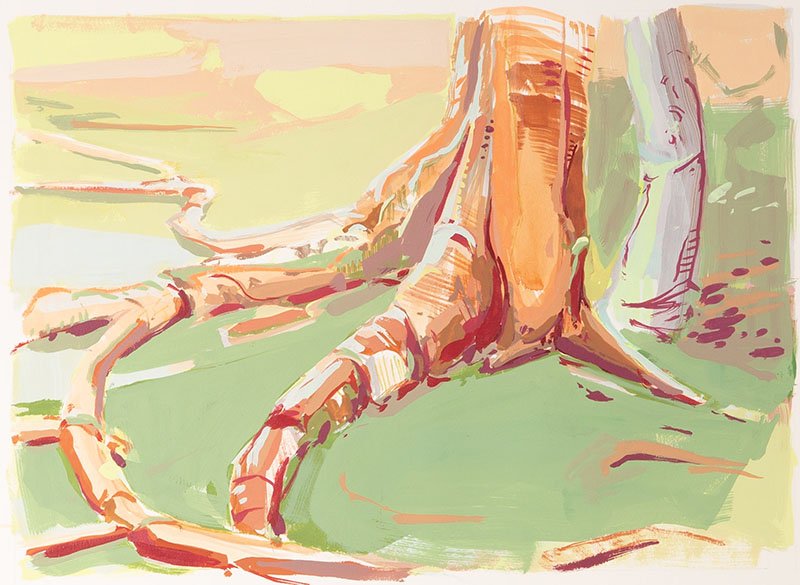
Amanda Bittner: “September 8, 2022 (No. 8),” gouache on Rives BFK, 16” x 20”, 2026
Amanda Bittner: “Uneven Ground”
My work is a byproduct, an artifact, and a love letter to a moment in time spent noticing. I traverse local patches of wildness slowly and lovingly, observing the weeping sap of eastern white pines, the decay of ghost flowers, and the spring hum of spiders. While the deer flee, the black-capped chickadees perch upon my easel. I am a witness to the secret choreographies of the woods—a beaver building a dam, a coyote watching from the brush.
My sites are curious places that invite an investigation of both the self and the surroundings. Like Henry Wadsworth Longfellow, I seek the harmonies and discords between the human and the wild. On this uneven ground, between glacial erratic and dying beech, I write my love letters in ink and paint. Their words are composed of varying hues and gestural marks—a transcendent, constructed tongue used to talk to the mute.
Rooting
This work is rooted in the "grit" of the New England 67 Challenge—summiting all sixty-seven 4,000-foot peaks across Vermont, New Hampshire and Maine. On these vertical staircases of rock and root, safety requires a downward gaze. It was through this constant, necessary scanning of the ground for footing that I fell in love with the forest floor. On the forest floor, I see the cycle of life and death in its most concentrated form. The gnarled root systems ebbing and flowing above and below the soil speak of a resilience and wisdom I can never fully possess.
Trail Boundaries
From 2022 to 2024, I painted the root systems of twenty trees in a single grove at Ravenswood Park. As I became attuned to the rhythms of the wildlife, I grew increasingly uneasy with my own presence. I grappled with the trail boundary—the thin line between witness and intruder. Should I be here? Am I a part of this system, or an intruder protected by DEET? After an encounter with an owl protecting its fledglings, I felt the weight of my own intrusion. I chose to leave Ravenswood, allowing the birch grove to heal from my presence. This body of work, then, is an act of memory and reconciliation.
Painting Process
While the foundational sketches and oil paintings were created en plein air over two years of field observation, these final works were realized in the studio, primarily during a residency at Millay Arts in January 2026. Moving away from the literal "local color" of the landscape, I used my field references to explore a more gestural, abstract language in gouache. These paintings are a translation of the landscape—shifting from the technical accuracy of the hiker's gaze to the emotional resonance of my own memory.